

A personal update.
First, I’d like to say thank you for your patience while I took some time off from writing this newsletter. A few things happened!
I bought a house and moved to a new area of town. If you’ve ever moved, you know how taxing that can be.
I took on a new project at GitHub, leading our joint go-to-market strategy for GitHub Copilot, our hero AI product. It’s been an amazing learning opportunity, and also very busy.
I went to England and participated in the Oxford Media Policy Summer Institute, which was two weeks long and an AMAZING experience. The theme was “technology in turbulent times” and I learned so much from the other participants. I highly recommend this program if you’re interested in learning from others and engaging in conversations about media, tech and global policy.
My partner, Kurt, showed up on the last day of the workshop so we could begin a week long holiday in England. He proposed the next morning on the Oxford campus, and I said “yes, please”. I was absolutely shocked, and I’m so happy to report that we’re engaged! (See photos below, or skip them if you’re just here for the AI. :) )
That’s what I’ve been up to these last many months while the AI Weekly Update has been on hold. Fortunately, after some reflection, I’m glad to be back writing the weekly newsletter, and I have a fresh vision for what it can and should be. The subject matter is going to remain focused on AI, but will shift to include more commentary on policy and the many changes across the landscape of AI. So…let’s get into it!


The AI Copyright Debate
The Context:
Large Language Models (LLMs) are trained on huge amounts of data which can include anything from blogs on the internet, to academic papers to interviews and, possibly books.
Meta, Microsoft, OpenAI and Stability AI are all named in lawsuits which claim that the companies infringed on the authors’ copyright by using their books to train the LLMs, and not paying them for that use.
Similar lawsuits have been brought to these and other companies claiming that generative AI models creating visual images have similarly infringed on the copyrights of artists and creators.
The Challenge:
Companies are claiming that use of the copyrighted materials falls under the protection of the “Fair Use Doctrine”.
According to the Harvard Office of the General Counsel, “Fair use is the right to use a copyrighted work under certain conditions without the permission of the copyright owner. The doctrine helps prevent a rigid application of copyright law that would stifle the very creativity the law is designed to foster.”
An additional challenge is knowing what information an LLM has used to create a response. If asked to share a summary of a book, the LLM might leverage its knowledge of the actual book itself, but could also rely on book summaries and reviews from the internet to write a bespoke summary. It is incredibly hard to know whether the output was trained on the book itself or information publicly available on the internet.
Why it Matters:
The cases haven’t yet gone to court, and no decisions have been made related to whether this is an infringement on the copyright of the authors and artists in question, but it’s almost certain to be a lengthy battle that could go all the way to the Supreme Court. A decision that favors the large tech companies could protect innovation and drive AI industry growth, but would certainly be a blow to authors and artists. Either way, the outcome will shape the future of AI generated works and massively shift the landscape of creation.
Where we go from here:
Mainly, we wait for the outcomes of the court cases.
In the uncertainty, people are asking questions about whether or not a digital signature could be applied to copyrighted works that would let creators know when their works had been used to answer a question or create an image. While this technology would be complicated to create and is a ways off, it could help bring clarity to these deep learning models where a lot happens in a “black box”.
AI Policy Updates
Google’s Approach to AI in Politics
Google updated its political content policy, requiring election advertisers using YouTube and Google platforms to disclose if the ads “contain synthetic content that inauthentically depicts real or realistic-looking people or events” - essentially, if the ad uses AI to generate images or videos that depict real people or events, but which were not, in fact, real. The move has broad support from state and federal politicians in anticipation of the upcoming election.
The US warning to the EU about the EU AI Act
In recently disclosed documents, the United States warned the EU that its landmark AI Act has the potential to disproportionally benefit big businesses, while leaving smaller businesses struggling.
According to Bloomberg news, which exclusively and confidentially obtained the documents, the United States found the European Parliament's legislation to be “vague or undefined”. The comments from the US to the EU were intended in the spirit of cooperation and with shared goals for AI development in mind. The comments have resonated with some in the EU, and have led to broader conversation about the AI Act. The AI Act will be a first-of-its-kind legislation, and the AI and policy world is watching closely to see how the final policy shapes up.
TikTok of the Week
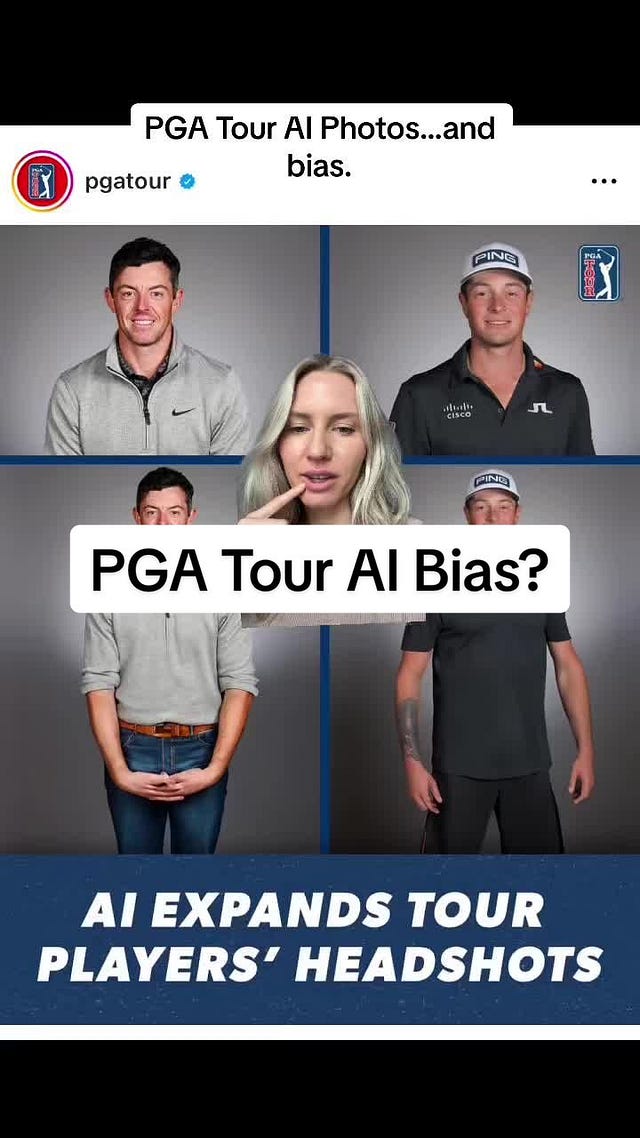
PGA AI-Completed photos…and bias?
 Tiktok failed to load.
Enable 3rd party cookies or use another browser
Ask your AI Question.
Submit your AI question here - it can be a responsible AI, AI policy or general AI question. I’ll pick one to respond to every week!
Let’s Connect.
Connect with me on LinkedIn.
Follow on TikTok, where I talk about developments in responsible AI.
Email me thepaigelord@gmail.com if you want to connect 1:1.
Congrats on all the wonderful announcements!
Congratulations!!! Y’all look so happy.