


A personal note: For the “deeper dive” section, I’m going to make some adjustments by alternating between true deeper dives (which take a few weeks to research and write because I do not use AI to write them) and other, less lengthy looks into trends or ideas related to AI ethics & policy.
The Latest:
THE EU AI ACT HAS PASSED - On March 13th, the EU AI Act - the world’s first major regulation on AI - passed in the European Parliament with overwhelming support. It will take up to 2 years before the entire Act is in force, but for high-risk technology, the Act will be in force as soon as a few months from the passage.
AI RESEARCHERS FEAR COMPANIES MAY HINDER INDEPENDENT EVALUATIONS - Independent researchers working on LLMs claim that company’s policies meant to keep bad actors from abusing AI have lead to a chilling effect on research. Independent researcher using the LLMs to identify gaps, understand biases, etc., are at risk of being banned or sued if they test the technology. Over 100 AI researchers have signed a letter to gen AI companies asking for access to their systems for testing and research purposes.
THE CLOCK ON TIKTOK - TikTok, a popular video social media app and subsidiary company to ByteDance is awaiting their fate. On March 13th, 2024, the US House of Representatives passed a bill stating that TikTok is to be banned unless the US portion of the company is sold to an owner in the US. This comes as concern for American’s privacy is mounting as more and more data is collected through the app. The Senate still has to vote, and as TikTok awaits its fate it has turned to prompting TikTok users to contact Congress and prompt them not to pass the bill in the Senate.
*Paige works for GitHub, which is owned by Microsoft.
Deeper Dive:
Google & Responsible AI: 7 Years of Blunders, and the Way Back to Trust
Google launched its multi-modal AI model Gemini with a beautiful campaign outlining the technology’s potential. The technology can ingest inputs in multiple forms, and return outputs in multiple forms, too. This next wave of AI is, in short, incredible. Just three weeks after its launch, users of the model realized that requests for images with humans yielded only those of people with darker skin tones. A social media outcry backed by “receipts” led to Google halting the image generation portion of the service not long after its launch. This is just the latest in a series of responsible AI challenges experienced by the tech giant, which continues to be a target for AI critics and watchdogs.
Since the dawn of the “AI Era” as we know it, we’ve seen Google struggle to gain its balance as other major companies pull ahead, release models, form partnerships and, in general, enjoy success while also claiming to prioritize responsible AI. Google has had at least one major responsible AI blunder every year since 2018. The company’s inability to gain its balance appears to be largely due to a disjointed approach to, and execution of, responsible AI priorities and processes, compounded by challenges with other inadequate internal HR and communications processes. This deeper dive looks at Google’s significant responsible AI (RAI) challenges over time, examines how Google ended up as less-than-dependable in the world of RAI (and AI in general), and what Google can do to get back on track.
Note from the author: It’s important to disclose that I work for GitHub, which is owned by Microsoft - one of Google’s competitors. However, I am an AI ethicist, and I am on the side of responsible AI. I take no joy or pleasure in Google (or any of Microsoft’s competitors) failing to launch AI responsibly. If Google comes back from these challenges with a stronger stance that moves responsible AI forward (and I think that they will) that’s a win for humanity and I would welcome that success with open arms. The opinions expressed in this article and in my newsletter are my own. Now back to the article.
It should be clear that Google’s contribution to AI hasn’t been all bad, and we also don’t have a look into the innerworkings of Google’s current responsible AI work, which means we can only evaluate what’s publicly available to us. A peer of mine recently reminded me that large companies can be doing a host of massive, important, positive things and never make the news for it. It’s rare to see the internet praise a social media company for its commitment to expensive and time-consuming content moderation processes, for example. So, in the midst of the blunders, there have been positive advancements that Google can be proud of, like turning Bard into Gemini, and forming critical partnerships with opensource leaders like Hugging Face - and we should all keep these successes top-of-mind.
As of March 2024, Google’s approach to responsible AI, as shared with the public, appears to be two-pronged. The first prong includes a set of seven “objectives” for the technology, and the company’s commitment to them, which debuted after in 2018 in a document called “Artificial Intelligence at Google: our principles” after a controversy pushed the company to create principles and standard for creation, deployment and use of AI. The second prog provides guidance across four responsible AI ‘practices’: fairness, interpretability, privacy, and safety and security. For each of these practices, Google offers a series of recommended actions that others can take when building, deploying, or using AI. As we know, words and statements can only go so far, and Google has struggled swimming up the responsible AI stream since at least 2018.
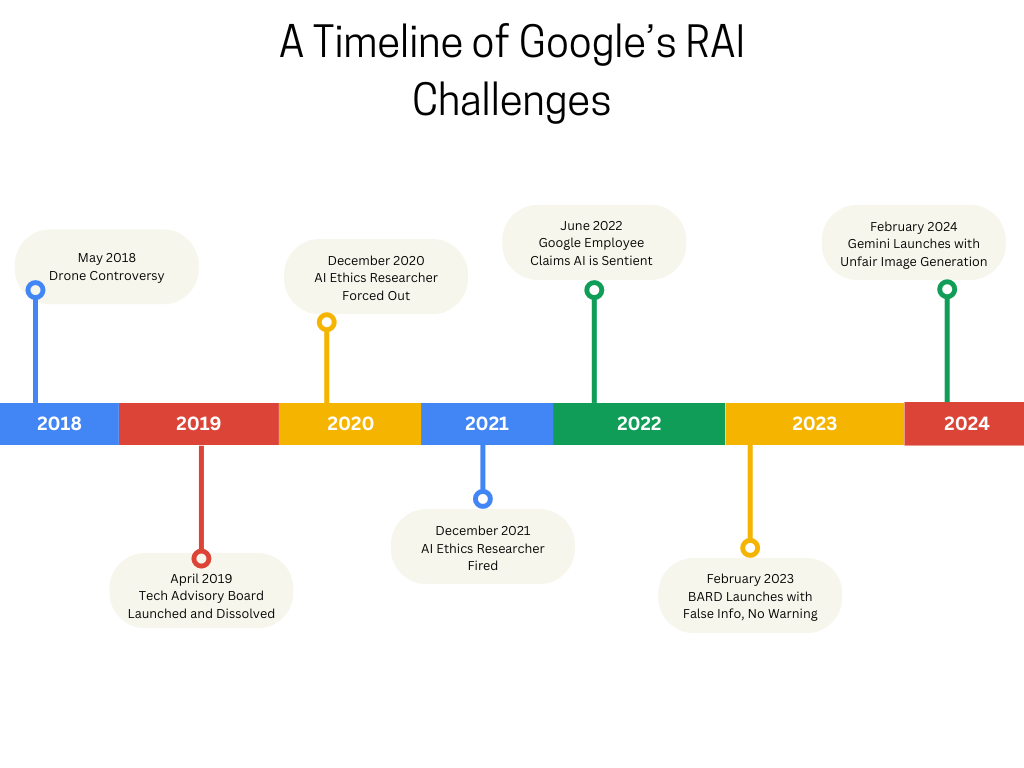
A timeline of Google’s Responsible AI Challenges:
Controversy 1:
US Government Drone Surveillance AI Controversy - May 2018
In May of 2018, Google employees raised their voices against Google’s partnership with the Pentagon, in which they would develop AI tools to analyze drone surveillance footage. Conflicting messaging further drove confusion, and employees were upset about the lack of a clear, principled stand. Google released a statement saying that the technology in question “flags images for human review” and is used for “non-offensive uses only.” This is in stark contrast to the email then head of Google Cloud Fei-Fei Li sent out stating that Google colleagues should “avoid at ALL COSTS any mention or implication of AI…weaponized AI is probably one of the most sensitized topics of AI - if not THE most. This is red meat to the media to find all ways to damage Google.”
Where it went wrong: A lack of clear guiding principles and boundaries on sensitive work (like military work), coupled with a lack of transparency and an attempt to hide the nature of the work being done (see the email from Fei-Fei Li) led to confusion for employees, causing distrust between the Google C-Suite and employees, and Google and consumers. Google created responsible AI principles only AFTER this blunder, raising questions about how Google was being guided up until the forcing-function of conflict led to the creation of principles.
Controversy 2:
External Tech Advisory Board is Launched and Immediately Dissolved - April 2019
After its challenges with the Pentagon contract, Google created and shared a list of responsible AI principles. A year after the release of the principles, Google formed the Advanced Technology External Advisory Council (ATEAC), which included a diverse group of members across business, academics, and policy. The board was dissolved shortly after it launched, due to company and public backlash at the inclusion of Heritage Foundation president Kay Coles James. According to The Verge, James is a “noted conservative figure who has openly espoused anti-LGBTQ rhetoric and, through the Heritage Foundation, fought efforts to extend rights to transgender individuals and to combat climate change.” Outcry from employees and consumers led to the dissolution of the board. A Google spokesperson stated “It’s become clear that in the current environment, ATEAC can’t function as we wanted. So we’re ending the council and going back to the drawing board.”
Where it went wrong: Creating a technology advisory council was a great idea, and incorporating diverse voices and perspectives is incredibly important. I believe this was Google’s intention. However, when selecting someone for technology council navigating complex issues around morals, ethics, and rights in technology, it is important those people not be actively working against human rights for some. While the board had not yet met or made decisions, the appointment of James signaled to the public that Google was willing to entertain the ideas and perspectives from someone who actively believes that transgender individuals should not have the same rights as everyone else. While this doesn’t violate the ethical principles set out by Google per se, it is in direct contrast to statements made by Google’s CEO about respecting human rights. This blunder significantly weakened people’s trust in Google’s ability to make meaningful moves to further the cause of responsible AI.
(This article is LONG! Click here to continue reading on LinkedIn.)
AI Policy Watch
Clay Higgins Proposes a Bill to Govern the Use of AI in the US Federal Government
Louisiana congressman Clay Higgins has proposed the Comment Integrity and Management Act of 2024 which, if passed, would provide the US government with the tools to accurately report the number of comments, respond to mass comments and to manage comments in general.
Washington State Creates an AI Task Force
Washington State Legislature passed Senate Bill 5838, which approves the creation of an Artificial Intelligence Task Force to help lawmakers better understand the potential impact of AI - both positive and negative. The task force will include 19 members from a variety of industries and fields.
States Take on AI
At least seven states in the US have taken the regulation of AI into their own hands, working to pass legislation that will work to mitigate the risks of bias in AI. There are over 400 AI-related bills being debated this year and, according to the Associated Press, they’re focused on regulating parts of AI, but not the technology as a whole. This is definitely something to keep an eye on in terms of proposal types, passages, and what lawmakers are overwhelmingly looking to regulate.
Europe Launches AI Office as “Global Reference Point”
Europe has launched the European AI Office, which will be “the centre of AI expertise across the EU” and will play a role in ensuring the implementation of the EU AI Act, supporting the development of trustworthy AI, and nurturing international cooperation.
Video of the Week
In case you missed it, here’s another look at Cooking & Baking with AI.
Worth a Read
Trustworthy AI Needs Trustworthy Measurements (Center for Democracy & Technology)
The Ethical Wisdom of AI Developers (Tricia A. Griffin, et al.)
Let’s Connect.
Connect with me on LinkedIn.
Subscribe on YouTube.
Follow on TikTok, where I talk about developments in responsible AI.
Email me thepaigelord@gmail.com if you want to connect 1:1.