


Major news this week:
US & CHINA AI ARMS RACE: ScaleAI wants to make a significant impact on the world by partnering with the US Government. According to the Washington Post, the AI startup, which began in 2016, has a mission to help companies organize and label their data for higher AI algorithm performance. Now, it wants to help the US military in its “AI arms race” with China. Its offers include helping the Pentagon derive better insights data, building autonomous vehicles, and also creating a chatbot to advise military leaders in combat. Some view these contributions as critical for establishing a US lead as an military AI leader, but many fear this will lead to a new type of warfare between global super powers, and question ScaleAI’s own ethical approach to AI given its use of “digital sweatshops” and failure to pay some Filipino contractors on time.
REUTERS’ REVIEW: This article gives a great summary of where countries are at in their race to regulate AI tools. I won’t recap it here, but the view put together gives insight into which countries have put regulations in place, are accepting commentary on regulations, or are investigating breaches by AI systems.
DHS and Facial Recognition Technology
The Context:
The US Department of Homeland Security has released a new policy for its use of face recognition and face capture technologies, and it raises some necessary questions. Below is the critical info about the policy update.
The DHS exists perpetually at the center of controversy. While its job is critical - to ensure the safety of the United States by securing the borders - how that end is achieved is a matter of opinion.
A preliminary search revealed that the DHS has been collecting face and biometric data since at least 2004 through organizations in its purview.
The new policy addresses the use of face recognition (FR), face capture (FC) and face analysis (FA) technology.
Policy update: The policy clears the use of FR and FC technology for “DHS missions” which include preventing terrorism, securing borders, enforcing immigration law, safeguarding cyber systems, and ensuring resilience when disasters occur." The DHS Inspector General’s office is not covered by this policy.
Policy update: Clearly outlines that FR and FC technologies are not used to gather information solely about individuals in protected groups, nor is it used “to enable systemic, indiscriminate, or wide-scale monitoring, surveillance, or tracking.”
Policy update: FR and FC systems must be inspected at least every 3 years while operational - inspections are run by the Science & Technology oversight committee and follow ISO/IEC standards and NIST guidelines for AI.
Policy update: FR matches cannot solely be used as the basis for law or civil enforcement, and must be reviewed by examiners before action is taken.
Policy update: U.S. citizens can opt out of non-law enforcement related actions or investigations. (Example: Global Entry FR use.)
Policy update: FR or FC data collected by DHS cannot be re-sold or re-shared.
Policy update: FA technology can only be used for age estimations.
The Challenge:
While the DHS updates to policy are admirable and are certainly a step in the right direction, Americans remain in the dark when it comes to understanding their rights with facial recognition technology. The DHS is an intimidating organization with a significant amount of authority, and lack of transparency with Americans and visitors around the use of such a complicated and fraught technology is irresponsible and erodes trust.
Why it Matters:
Facial recognition, facial capture and facial analysis technologies can be dangerous. The systems themselves and associated training data can be laced with bias, and the humans leveraging the technology can be biased as well. The policy changes are a strong start, but require oversight and transparency so the DHS can be held accountable.
Where we go from here:
From here, we continue to monitor changes to the way the US government and its associated entities update their policies related to AI. As AI becomes normalized, it is almost certain that governments the world over, including the United States, will have cases of over reach and misuse.
AI Policy Updates
President Biden’s Anticipated Executive Order for AI
Politico is reporting that President Biden will issue and Executive Order by the end of October which will help the United States create standards and catch up to the technology while maintaining America’s competitive position in AI. The Executive Order is expected to accomplish the following:
Require Cloud computing companies (Google, Amazon, Microsoft, etc.) to track cloud users who might be creating large AI systems.
Increase the ability to recruit and retain overseas AI talent.
Boost domestic AI education.
Possible reporting requirements for cloud computing providers.
Experts seem to believe that the Executive Order is aimed at codifying some of the non-binding standards and practices the White House has put forth, including the Blueprint for an AI Bill of Rights, the NIST AI Risk Management Framework, and the items to which the seven large AI companies agreed to at the White House in July of 2023. This move is seen as an effort to maintain some guardrails while Congress is in chaos and unable to regulate.
TikTok of the Week
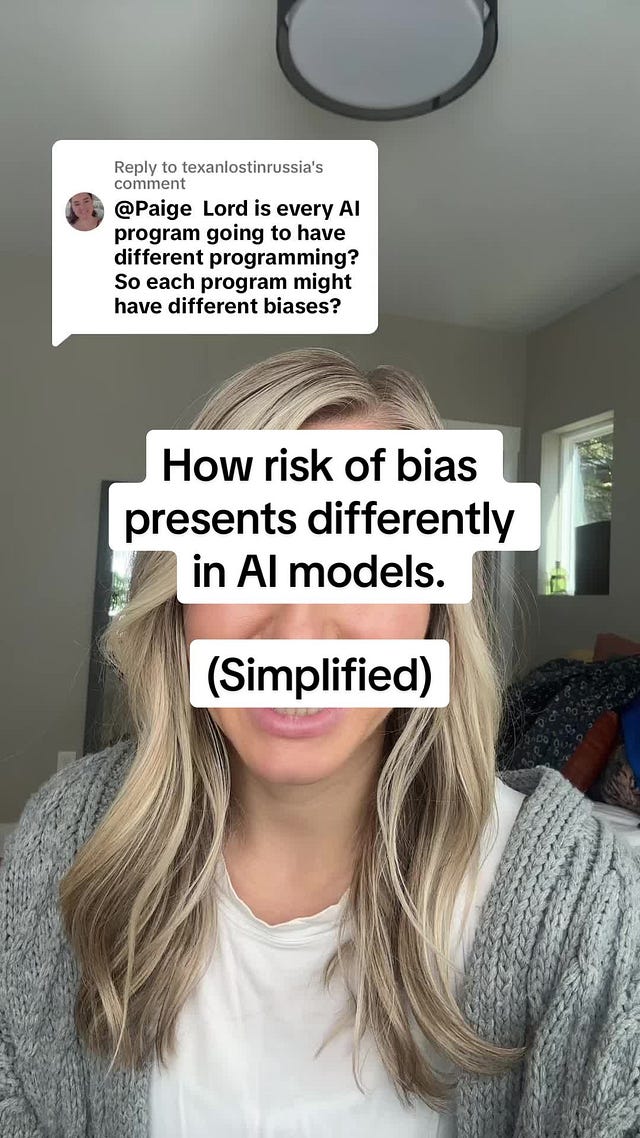
Different model, different bias - showcased by props I found on my desk.
 Tiktok failed to load.
Enable 3rd party cookies or use another browser
Ask your AI Question.
Submit your AI question here - it can be a responsible AI, AI policy or general AI question. I’ll pick one to respond to every week!
This week’s question: What are your thoughts on using ChatGPT or similar AI tools for clinical use or clinical research? This would include entering patient identifiable information into the tool / analyzing patient identifiable information? (Submitted anonymously.)
My response: A common use of ChatGPT or other large language models is reviewing a larger body of work and getting a summary. (I’ve heard of people doing this with resumes before they interview someone for a job.) I think this is incredibly useful, but we have to be careful about when and how we do this.
While there are certain items at work that I would love to submit to ChatGPT for a summary, I choose not to because it contains some sensitive information related to our customers. For clinical research in particular, I think staying away from using LLMs for now is a good idea. Unauthorized use with patient data not only compromises your job and the reputation of the institution, but the trust of the patient. When your institution has a contract with a company to use a secure version of their LLM, or creates their own LLM which protects patient data, then I would leverage the technology. But until your institution has that in place, I would opt-out.
Let’s Connect.
Connect with me on LinkedIn.
Follow on TikTok, where I talk about developments in responsible AI.
Email me thepaigelord@gmail.com if you want to connect 1:1.