

The EU AI ACT Officially Enters into Force TODAY - August 1st, 2024
Today is a big day for the EU as the EU AI Act officially goes into force. While it will take until 2026 for all aspects of the Act to go into force, this moment in time essentially starts the clock toward the full entry into force for all provisions. Read more here.
AI Ethics News
Notable news in the world of AI ethics and responsible AI.
Meta to Pay Texas $1.4B for Illegal Use of Facial Recognition Technology
Meta will pay the state of Texas $1.4B over the course of 5 years as a result of a settlement, for violating a law that protects against the use of facial recognition technology for commercial purposes. In 2022 Texas Attorney General Ken Paxton sued Meta for violating the 2009 law. Meta did not admit any wrongdoing in the settlement, and there has been no announcement yet about whether the money will be offered back to the residents impacted or put into a general fund for the State.
Watch my video on this subject to learn more and to get my perspective.
👉 Why it matters: This is a massive win for Texas, not just financially but in terms of protecting their residents. Texas put the law in question into place two years before Meta launched the “tag people” feature, for which the facial recognition technology was used. This highlights why it’s important for states to write laws to protect their citizens before the harm comes, rather than waiting to see what the effect will be.
Taco Bell is Rolling Out AI in the Drive-Thru
Taco Bell, which has been testing the use of AI for ordering at the drive-thru, will be rolling out AI to hundreds of US locations, citing that the test of the AI technology in a subset of Taco Bells actually led to more accurate orders and happier customers. The parent company Yum! Brands said that it had taken two years of research and testing to get the technology to this point, and that this will free up employees to focus on other critical tasks.
👉 Why it matters: This change will continue to spotlight the human wellness vs AI profit conversation. With AI being rolled out in fast food chains across the country, it is likely that these chains will see layoffs or less job availability in general. While right now the AI related layoffs and workforce changes seem “small” it will inevitably have an impact on the workforce and the economy.
AI in the Wild
NEW! This section will highlight new and interesting uses of AI, so you can stay up-to-date on how the technology is changing.
OpenAI Finally Releases Voice Mode, After Navigating Safety, Legal Concerns
OpenAI is finally releasing their long awaited “voice mode.” In past versions of OpenAI, users could dictate questions, but would get a written response back. With Voice Mode, ChatGPT can talk back to users in one of four options, pre-created with voice actors.
This comes on the heels of controversy for OpenAI as the initially shared their Voice Mode voice, named “Sky” and it sounded suspiciously like Scarlett Johansson. The company had asked Johansson if she would lend her voice for the feature, and she declined. After the remarkably similar voice debuted, Johansson took legal action to prevent the use. This lead to a change for OpenAI and a month delay in launching.

👉 Why it matters: This release brings up a number of safety concerns. The unauthorized use of Johansson’s voice and the subsequent use of voice actors to create the new voices to avoid impersonation addresses one safety concern. The other is whether people will emotionally form relationships with ChatGPT now that the AI has a very real sounding voice to engage with.
AI Policy Beat
A look at what’s happening in the world of AI policy.
Microsoft’s Generative AI Policy Recommendations
This week Microsoft released a 42 page report with suggestions for US legislative and policy measures that can immediately be taken to protect people from what the company is calling “abusive AI-generated content”. The guidelines circle three major aims: to protect elections, protect senior and consumers from online fraud, and protect women and children from online exploitation. Access the report here.
👉 Why it matters: As the election draws nearer, and as generative AI is scaled more broadly, we’re seeing more misuse of the technology and more harm done to vulnerable people. These suggestions are steps that can immediately be taken to work to protect people, and the research was done by Microsoft with their own funding and resources, providing a leg up to non-technical legislators who may be seeking to understand what changes might be taken to bring about swift protection.
The FTC Throws its Weight Behind Open AI Models
Open AI models (versus closed AI models) is a key debate in the AI community right now, and the FTC believes that open models will “promote competition” in ways that closed models cannot. According to FTC Chair Lina Khan, “Open-weight models can liberate startups from the arbitrary whims of closed developers and cloud gatekeepers.”
👉 Why it matters: As more companies race to create their own language models (large and small) many are coming out with closed models in an effort to protect the work and investment that went into creating the model. However, this stifles innovation by working against model transparency, which allows developers to customize the models and make them more accessible to smaller companies.
OpenAI Endorses Senate Bills
OpenAI has thrown its weight behind three Senate bills as companies move to help shape the future of AI regulation. The three bills are the Future of AI Innovation Act, which would authorize the US AI Safety Institute as a federal body that would set standards for AI models, the NSF AI Education Act and the Create AI Act which would provide federal funding for AI research and infuse AI education within educational institutions, including K-12.

👉 Why it matters: With the EU AI Act officially going into force, there is increasing pressure on the United States to not only make a move with regard to AI regulation, but to make the right moves that will protect people but not hinder innovation. Companies will continue to throw their weight behind the bills that will champion innovation. This is an area to watch.
Spotlight on Research
Why AI Can’t Substitute Teachers
This article dives into the experiment that lead to the conclusion that AI cannot substitute a teacher.
Public vs Private Bodies: Who Should Run Advanced AI Evaluations and Audits? A Three-Step Logic Based on Case Studies of High-Risk Industries
AI Safety Institutes and governments are debating whether to evaluate and audit advanced AI themselves, support a private auditor ecosystem, or both. Auditing regimes exist in various industries to ensure regulatory compliance and are essential for managing technology risks. This paper examines nine such regimes to inform (i) who should audit advanced AI and (ii) the resources, competence, and access public bodies need to audit advanced AI effectively.Identifying and then implementing an effective response to disruptive new AI technologies is enormously challenging for any business looking to integrate AI into their operations, as well as regulators looking to leverage AI-related innovation as a mechanism for achieving regional economic growth. These business and regulatory challenges are particularly significant given the broad reach of AI, as well as the multiple uncertainties surrounding such technologies and their future development and effects. This article identifies two promising strategies for meeting the AI challenge, focusing on the example of Fintech.
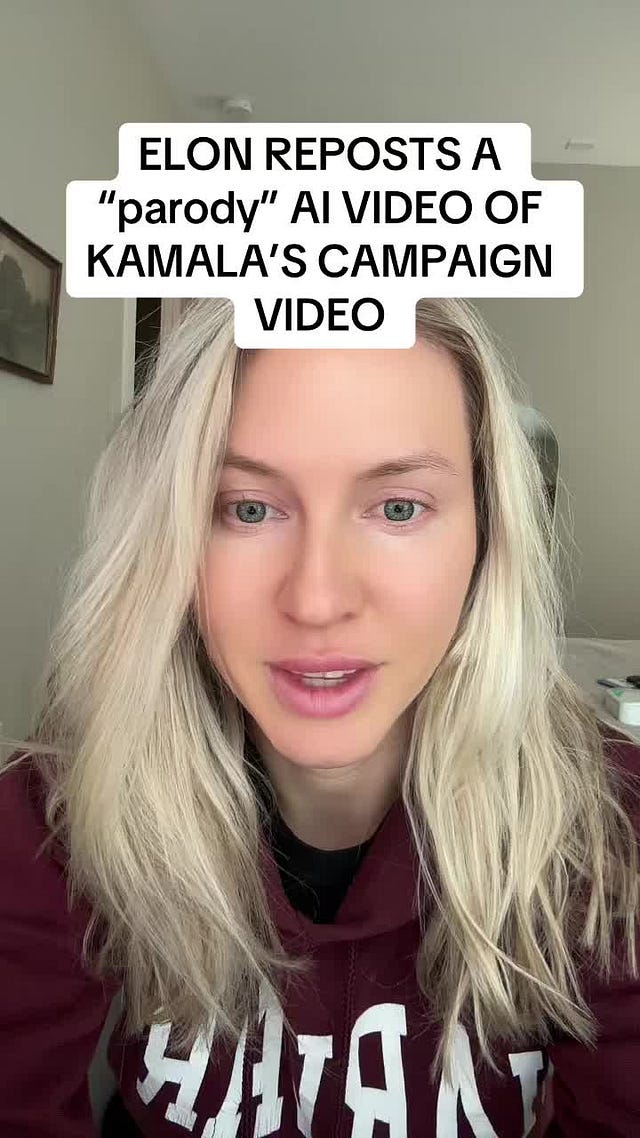
WATCH: Elon Musk Re-Posts “parody” AI-Altered Election Campaign Ad
Here’s some content from my other mediums. Feel free to follow me on Instagram, TikTok or YouTube.
 Tiktok failed to load.
Enable 3rd party cookies or use another browser
Let’s Connect:
Connect with me on LinkedIn.
Looking for a speaker at your next AI event? Email thepaigelord@gmail.com.
Email thepaigelord@gmail.com if you want to connect 1:1.