


Feature: Donald Trump Repeats Claims that the Harris Campaign Used AI Generated Images Falsify Crowd Sizes
Politics can be divisive. Please remember that I am reporting on this as an advocate for the responsible use of AI, and not as an advocate for a political party.
Photos circulating on X, TikTok, and other social media claim that the Harris-Walz campaign is lying about rally crowd sizes using AI-generated images. This claim was repeated by Republican Presidential Nominee Donald Trump on Truth Social on August 11th. Multiple news organizations have reported that the claim is false, with no evidence supporting it.
Below is one of the images being circulated by both humans and what appear to be bot accounts, indicating that this is one of the “zoomed in” views of the Harris/Walz rally crowds. There is no evidence that this image is a “zoomed in” version of any of the public images shared from the rallies in question.

👉 Why it matters: The use of AI for election disinformation is increasing rapidly. AI-generated audio, video, and images are being used to create false narratives. In this case, one political party appears to be using AI images to accuse the other of doing the same. This disinformation confuses voters, especially vulnerable populations like the elderly. Since content creation is protected by free speech and often produced by citizens rather than political campaigns, it's unlikely that measures will be taken to stop it in this election. (If you have more information or evidence on this matter, or other matters related to AI generated content use in the election, please share with me at thepaigelord@gmail.com.)
Please see my video on AI use in the election for a deeper look at what we’re seeing.
AI Ethics News
Notable news in the world of AI ethics and responsible AI.
Publishers are Selling Materials to AI Companies
Many publishers are entering deals worth up to $75M with AI companies to sell authors' works for improving research and highlighting researchers' roles in an AI-enabled world. Publishers like Taylor & Francis, Wiley, and Oxford University Press are involved, with some compensating authors and others not. Oxford University Press offers authors an "opt-in" option.
👉 Why it matters: This sale highlights the challenges faced by original content creators, who rely on publishers for legitimacy. The sale of authors' work to train LLMs, often without notification or compensation, underscores a significant inequity, commodifying authors' time, talent, and effort.
Big News for Robots
DeepMind reports that a robot using DeepMind AI is able to play pingpong at an “amateur human level”. In the age of AI where ChatGPT can share an email draft in seconds, this may not seem very impressive, but it is.
👉 Why it matters: The field of generative AI (ChatGPT, Claude, etc.) is very different from the field of robotics, although they’re both branches of AI. Moravec’s Paradox is a theory that claims that things that are hard for humans (complex math) are easy for robots, and things that are easy for humans (picking up a coin, or playing ping pong) are hard for robots. Well, Google DeepMind is making major progress toward flipping the Paradox on its head. The more agile and dexterous robots can be, the closer humanity will get to the creation of humanoid robots, which will present a new and complicated set of ethical challenges for humanity.
AI assistants at JP Morgan Chase
JPMorgan Chase has launched a generative AI assistant, LLM Suite, to over 60,000 employees. LLM Suite leverages external LLM software and assists with tasks like writing emails and reports and aims to be as ubiquitous as Zoom within the bank.

👉 Why it matters: JPMorgan's adoption of generative AI reflects its rapid integration into corporate America. It is believed that the AI assistant will enhance employee productivity and could revolutionize work processes and will definitely be interesting to watch. This also highlights the desire of companies to provide LLMs for people to use in a controlled, secure environment, rather than risking that employees use external, potentially less-secure AI platforms. CEO Jamie Dimon highlighted the technology's potential to augment nearly every job at the bank, enhancing efficiency and potentially reshaping the industry.
AI in the Wild
NEW! This section will highlight new and interesting uses of AI, so you can stay up-to-date on how the technology is changing.
The Perilous World of Age Assurance Technology
The Washington Post reported that AI age verification tools are being used to estimate ages by analyzing facial patterns. Companies like Yoti, Incode, and VerifyMyAge require users to upload video selfies and IDs in order to verify their age. These tools are gaining popularity among lawmakers for protecting children online but raise significant privacy concerns.
👉 Why it matters:
The widespread use of AI age scanners poses privacy risks, potentially exposing sensitive data to misuse. While the tools aim to protect children, they also require extensive data collection (licenses, IDs, etc.), subjecting all users to surveillance. Critics argue that this level of inspection could lead to increased government oversight and potential misuse of personal data. This could very easily become a case of using AI to try and solve one problem, but opening up a new set of significant, perhaps more damaging, challenges along the way.
AI Policy Beat
A look at what’s happening in the world of AI policy.
California & NVIDIA Partner to Bring AI Resources to Californians
Governor Gavin Newsom and NVIDIA founder & CEO Jensen Huang partnered to bring the power of AI to residents of California. The partnership is aimed at training students, educators and workers on AI, supporting job creation and promoting innovation, and using AI to solve challenges that face Californians, according to the press release from the California State Government.

👉 Why it matters: Big tech companies often have resources and insights that can be beneficial to governments attempting to enact change at the pace of innovation. By partnering together to provide these AI educational and innovation resources, Californians will have a chance to learn new skills, which could prepare them for new types of jobs in the AI era, and the chance to use AI to solve problems that residents of the state face.
Integrating AI into Defense Systems
In 2021, Australia, the UK, and the US formed a partnership called AUKUS to provide Australia with submarines and collaborate on military advancements, aiming to enhance security and stability in the Indo-Pacific region. Recently, AI was integrated into unmanned aerial vehicles (UAVs) and passed a benchmark to complete missions and maintain network connectivity “across multi-domain battlespaces, including land, maritime, air, and cyberspace.”

👉 Why it matters: China is a known aggressor in the Indo-Pacific, a region with over 40 countries and economies. The US Government reports that Beijing intimidates and bullies other nations out of resource access. This is compounded by China's aggressive pursuit of US AI technology, which the Biden Administration fears will be used for advanced AI military weapons. Utilizing AI to gather information across various battle environments could lead to faster intelligence and more precise military decisions.
FCC Seeks to Crack Down on AI Robocallers
The Federal Communications Commission has proposed new rules that would require robocallers to clearly disclose when they’re using AI in communications, including phone calls and text messages. The FCC proposes defining an AI Generated Call as “an artificial or prerecorded voice or a text using computational technology or other machine learning including predictive algorithms, and large language models, to process natural language and produce voice or text content to communicate with a called party over an outbound telephone call.”
👉 Why it matters: With AI becoming more sophisticated, useful and accessible, AI’s ability to fool people has also increased. Companies and institutions are increasingly using AI to contact individuals, leading some individuals to be annoyed, and others to be scammed or fooled. This effort by the FCC seeks to keep AI robocalls transparent while not stifling the use of AI for those with speech and hearing disabilities. The FCC is seeking comment from those who could help them understand how they could update their proposed rules to ensure that scammers cannot abuse the exemption.
Spotlight on Research
"We need to prepare for addictive intelligence" from MIT Technology Review discusses the emerging risks associated with AI companions. As AI systems become more integrated into daily life as friends, lovers, mentors, therapists, and teachers, the potential for addictive behavior increases. The authors highlight that while much of the focus has been on doomsday scenarios, the more immediate concern is the deep emotional bonds people may form with AI, which could lead to significant societal impacts. The article calls for new scientific inquiry and regulatory approaches to address these risks, emphasizing the need for safeguards in AI design to prevent harmful dependencies.
Runtime Guardrails in Foundation Model based Systems
The rapid advancement and deployment of foundation model (FM) based systems have transformed many applications but also raised concerns about responsible AI and safety. Recently, there has been a focus on implementing guardrails to ensure safe and responsible runtime behavior of FM-based systems. However, the systematic study of guardrail design for these early-stage FMs and their applications remains limited. It is unclear which software qualities should be considered and how to ensure them from a software architecture perspective. This paper presents a taxonomy to classify and compare the characteristics and design options of guardrails, organized into three categories: motivation for adopting runtime guardrails, quality attributes to consider, and available design options. This taxonomy provides structured guidance for architectural design decisions and highlights trade-offs in the design process.The European Union’s Artificial Intelligence Act (AI Act) integrates AI research and innovation with legal standards. Clear definitions accessible to both AI experts and lawyers are crucial for its effectiveness. This paper analyzes key AI terms—AI system, general-purpose AI system, foundation model, and generative AI—across various versions of the legal text (Commission proposal, Parliament position, and Council General Approach) before the final political agreement. The aim is to bridge the understanding between technical and legal communities for proper implementation of the AI Act. The scientific foundation of AI systems and their role in regulation, the evolution of general-purpose AI systems, and the distinction between AI systems and AI models are examined. It concludes that defining foundation models based on general-purpose capabilities using standardized evaluation methods is most appropriate. Additionally, it argues that definitions of AI systems that include “content” as an output already cover generative AI, noting that not all generative AI relies on foundation models.
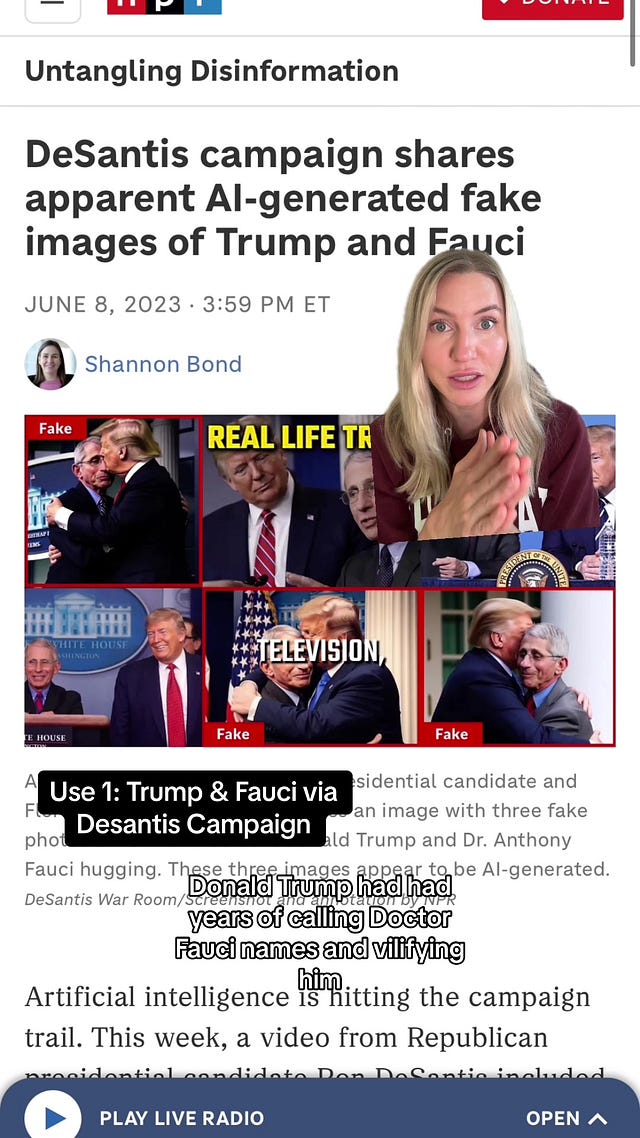
WATCH: A Look at Uses of AI in the US Presidential Election So Far
Here’s some content from my other mediums. Feel free to follow me on Instagram, TikTok or YouTube.
 Tiktok failed to load.
Enable 3rd party cookies or use another browser
👉 Take the Quiz: https://www.realornotquiz.com/
Let’s Connect:
Connect with me on LinkedIn.
Looking for a speaker at your next AI event? Email thepaigelord@gmail.com.
Email thepaigelord@gmail.com if you want to connect 1:1.