


Quick Hits 👏
NEW! Interesting AI news from the week that I won’t explore in-depth, but is important to acknowledge in the current AI moment.
Dell Lays off 12,500 People to Pivot to AI - Yahoo Finance
Wendy’s is on an AI Digital Transformation - PYMTS
John Schulman, OpenAI Co-Founder, Leaves OpenAI - TechCrunch
AI Ethics News
Notable news in the world of AI ethics and responsible AI.
NVIDIA’s Data Scraping Red Flag 🚩
According to leaked documents obtained by 404 Media reveal a startling fact about Nvidia, the company primarily known for its AI chip manufacturing. The company reportedly scraped huge amounts of data from YouTube to train its AI models, but the move wasn’t approved by YouTube. Employees of Nvidia reported raised the flag about the data collection but were told it was approved by someone higher up in the company.

👉 Why it matters: Nvidia isn’t the only company to do this, but reports of companies scraping massive amounts of data continue to appear at an alarming rate. If you read the newsletter last week, you know that Anthropic’s web crawler hit a company’s server over a million times in a 24 hour period, violating their terms of service. Anthropic responded by saying the onus to block the crawler was on the business, not on them. The outstanding questions about copyright and consent still remain unanswered in the AI landscape, leaving plenty of room for AI companies to gather whatever data they like from public sites.
Google Takes Action to Tackle Non-Consensual Deepfakes
Google has begun to take action to deal with the increase in explicit deepfakes. The company will take steps to keep the content from appearing in search results, and will also make it easier for victims to request that the content be removed. In addition to removing originals, it will work to remove duplicate content, and it will downrank search results that may lead to the explicit fake content, instead sharing higher quality, non-explicit content.

👉 Why it matters: Many countries, including the US, do not have regulation and laws in place to allow law enforcement to prosecute the creators of the abusive generative AI content. This means that the responsibility to manage the content lies heavily on the shoulders of tech companies like Google (Google Search, YouTube), Meta (Facebook, Instagram), and ByteDance (TikTok). While these changes will not keep the content from being created or posted, it could minimize the likelihood of people finding the content, a small comfort to victims. Google can, and should, be more aggressive in their approach to this kind of content, but without a law or a ruling the company is likely considering a more aggressive stance to be risky.
Google, The Monopoly 🎩 (and antitrust in AI)
Google is a monopoly (in search). Judge Amit Mehta of the US District Court for the District of Columbia made the ruling on August 5th. This decision marks the DOJ’s largest antitrust case since its action against Microsoft in the 1990s. The case centered on Google’s exclusive agreements with major companies to be their default search engine on both smartphones and the web, which the court found to hinder competition.
👉 Why it matters: Although this case is not directly about AI, it highlights a growing focus on antitrust issues that will likely affect the tech industry, including AI. As AI technologies advance, large tech companies are acquiring smaller AI firms and making strategic investments to gain a competitive edge. This ruling underscores the scrutiny that major tech firms face and sets a precedent for how such practices may be regulated. Antitrust actions can influence everything from market competition to data privacy and public trust in technology companies. As AI continues to evolve, similar regulatory and competitive concerns are expected to shape its development and deployment.
AI in the Wild
NEW! This section will highlight new and interesting uses of AI, so you can stay up-to-date on how the technology is changing.
ProRata.ai Captures the Attention of Major Media Companies, Raises $25M
ProRata.ai is working to make generative AI more fair by using its patented LLM to power its yet-to-be-released AI chatbot. Why is this different from OpenAI or another AI chatbot? Because it will be trained on material with permission, attribute outputs to creators of content, and split the subscription fees with content licensing partners.
ProRata’s approach is different than that of OpenAI and others. Right now, generative AI chatbot technology is largely trained on content that’s been scraped from the web or large libraries of data - usually without permission. AI companies employing this technique are facing lawsuits for copyright infringement, but they claim that their use of copyrighted material falls under the protection of “fair use” making it okay to grab the data from the internet and use it to train their models, without pointing back to original creators. These lawsuits have yet to be ruled on.

👉 Why it matters:
ProRata.ai proposes partnering with content owners of all kinds (from authors to artists) to leverage their work to train their LLM, and then attribute any resulting outputs influenced by their work to the creator in question. This means they will have permission to use the content, they will point back to the creator, and the creator can make money for the use of their work.
While ProRata is relatively untested, the idea is sound. The revelation that an attributive LLM is possible might lead some to ask: if it was possible this whole time why didn’t larger companies do that? We may never know, but it looks like ProRate.ai is the AI definition of “if they wanted to, they would.”
AI Policy Beat
A look at what’s happening in the world of AI policy.
Election Officials Send a Letter to Elon, X, To Curb the Spread of AI Misinformation
On August 5th, Election officials from five states sent a letter the Elon Musk, CEO of X, asking him to fix his chatbot Grok, which was sharing inaccurate voting information for over a week before it was finally corrected. The letter specifically calls out that the chatbot is sharing inaccurate voting information, including that VP, and presumptive nominee, Kamala Harris had missed the ballot deadline in several states.
👉 Why it matters: Americans are increasingly relying on AI chatbots to get their information and, despite warnings, are not fact checking the information they get before sharing it out to millions of people. This kind of oversight could lead people to not vote in their state because they may have been falsely informed that their candidate of choice was not on the ballot, or other information that leads them astray. This could cause a disruption to the democratic process.
Biden Harris Administration Gives Update on AI Executive Order Actions
The Biden Administration recently updated the progress on the AI Executive Order signed by President Biden in October 2023. This order outlined specific steps for federal agencies to ensure the responsible adoption and use of AI, with deliverables set for various timeframes. As of July 26, 2024, all actions due within the first 270 days have been completed.
👉 Why it matters: With no nationwide laws governing AI in the US, the AI Executive Order stands as a crucial federal initiative aimed at mitigating the risks associated with AI technology. This achievement is significant for two key reasons. First, it embeds responsible AI practices into federal processes, setting a high standard for AI use within the government. Second, it demonstrates that meaningful regulatory progress can be made relatively quickly. As the presidential election approaches, the outcome may shape future AI policies and regulatory approaches, making it essential to watch which candidate’s vision for AI will come to the forefront.
Spotlight on Research
AI for All: Identifying AI incidents Related to Diversity and Inclusion
The rapid growth of AI technologies has highlighted the need for diversity and inclusion (D&I) to address biases and prevent discrimination. Despite its importance, D&I is often neglected, leading to biased and unethical outcomes. This study examines D&I issues in AI by analyzing incident databases (AIID and AIAAIC) and developing a decision tree for investigating these concerns. Validated through card sorting and focus groups, the research finds that nearly half of the analyzed incidents involve D&I issues, with prevalent racial, gender, and age discrimination. The decision tree and public repository aim to enhance research and promote fair, inclusive AI practices.
Responsibility and Regulation: Exploring Social Measures of Trust in Medical AI
This paper explores expert accounts of autonomous systems (AS) development in the medical device domain (MD) involving applications of artificial intelligence (AI), machine learning (ML), and other algorithmic and mathematical modelling techniques. We frame our observations with respect to notions of responsible innovation (RI) and the emerging problem of how to do RI in practice. In contribution to the ongoing discourse surrounding trustworthy autonomous system (TAS) [29], we illuminate practical challenges inherent in deploying novel AS within existing governance structures, including domain specific regulations and policies, and rigorous testing and development processes, and discuss the implications of these for the distribution of responsibility in novel AI deployment.Hide and Seek: Fingerprinting Large Language Models with Evolutionary Learning
As the volume of content generated by Large Language Models (LLMs) has surged, accurately identifying and fingerprinting this text has become crucial. We introduce a novel black-box approach for LLM fingerprinting, achieving 72% accuracy in identifying model families (e.g., Llama, Mistral, Gemma). Our method uses an "Hide and Seek" algorithm with an Auditor LLM generating prompts and a Detective LLM analyzing responses to fingerprint models. This approach not only shows the feasibility of LLM-driven model identification but also provides insights into LLM semantic structures. By refining prompts through in-context learning, our system reveals subtle model distinctions, advancing LLM analysis, model attribution, and AI transparency.
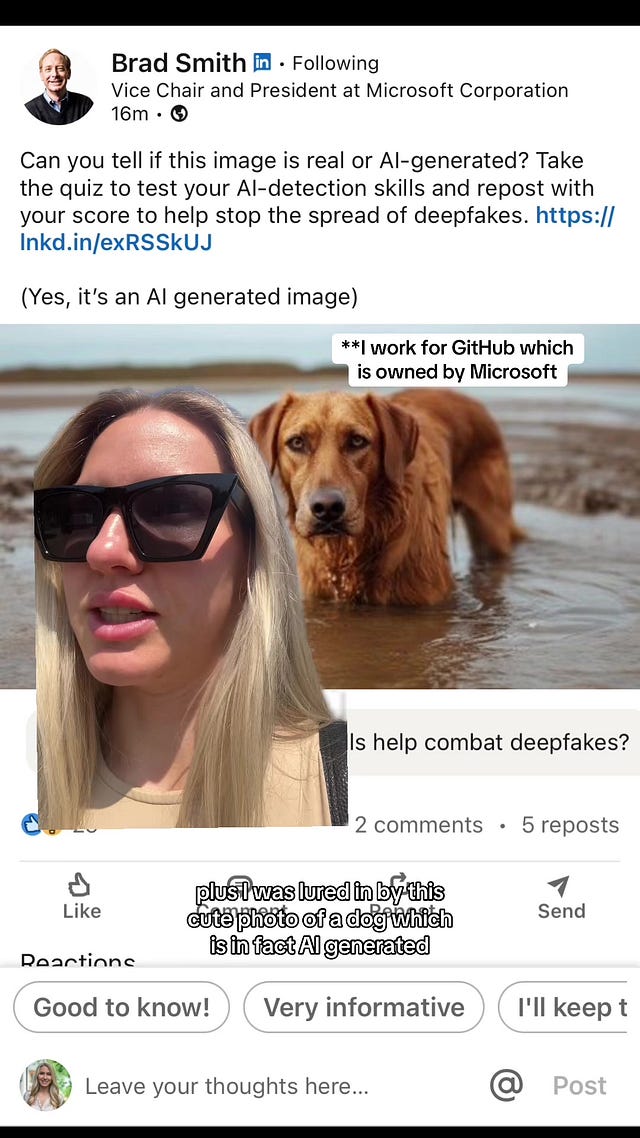
WATCH: Can YOU Tell the Difference Between Real and AI Generated Images?
Here’s some content from my other mediums. Feel free to follow me on Instagram, TikTok or YouTube.
 Tiktok failed to load.
Enable 3rd party cookies or use another browser
👉 Take the Quiz: https://www.realornotquiz.com/
Let’s Connect:
Connect with me on LinkedIn.
Looking for a speaker at your next AI event? Email thepaigelord@gmail.com.
Email thepaigelord@gmail.com if you want to connect 1:1.