


A note from Paige: I’m back to sharing the newsletter once a week because it was simply a lot to produce twice a week alongside other endeavors. Please let me know if you have feedback!
Quick Hits 👏
NEW! Interesting AI news from the week that I won’t explore in-depth, but is important to acknowledge in the current AI moment.
The National Institute of Standards and Technology (NIST) is Hiring
Professor Tasks Students with Creating AI Policy for Class - Inside Higher Ed
OpenAI Brings in Ex-Meta Executive to Lead Strategic Initiatives - PYMNTS
AI Ethics News
Notable news in the world of AI ethics and responsible AI.
Police are Using AI to Write Crime Reports
Police officers in Oklahoma City are using artificial intelligence to draft incident reports by analyzing data from microphones and radio communications. The Oklahoma City Police Department is among the few experimenting with AI to create initial report drafts, which could significantly reduce time spent on report writing and data entry.

👉 Why it matters: There are risks associated with this approach, including the potential for inaccuracies in AI-generated reports, over-reliance by officers who might neglect to review and update the reports, and the possibility of deflecting blame onto the AI for any inaccuracies if questioned in court.
San Francisco sues Creators of AI Technology that Enables AI to “Undress” Women and Girls
The city of San Francisco is taking legal action against AI websites and platforms that enable the creation of explicit images of women and children, using artificial intelligence without their consent. The complaint reveals that these platforms were accessed over 200 million times in the first six months of 2024 and argues that victims experience significant psychological, emotional, economic, and reputational harm, with no practical way to prevent the unauthorized use of their likenesses.
👉 Why it matters: The slow development of artificial intelligence laws and policies has lagged behind the rapid rollout of AI technology, leading to widespread misuse and exposing individuals to harm with little to no legal protection. This lack of regulation means people have limited recourse to prevent harm from malicious AI applications or to seek damages when their likeness is used or reproduced on these websites. San Francisco's lawsuit against AI websites is a significant step that could increase pressure for national policies to prevent such misuse, potentially restricting the availability of AI tools that facilitate these harmful practices and allowing for charges to be brought against perpetrators.
AI in the Wild
This section will highlight new and interesting uses of AI, so you can stay up-to-date on how the technology is changing.
The Growing Challenge of Exploitative AI Images
In a New York Times interview, Jenna Ortega stated “I hate A.I.” She acknowledged that it could be used for good, but she had seen the abuses of the technology first hand. When someone sent her sexually explicit AI-generated images of herself, she knew it was time to delete her Twitter account.
AI applications created for the purpose of “undressing” and “nudifying” photos are rapidly being created and deployed. “Face-swap” tools can place the face of a person on pornographic photos. All of this can be done without a person’s consent, and the photos can be broadly shared, as was the case with the fake explicit Taylor Swift, one post of which was seen over 40M times.
NBC news reported on the Facebook ads run by an app called Perky AI, which “advertised that it could undress women with artificial intelligence.” One of their ads ran with a photo of a 16 year old Jenna Ortega. There are other major concerns with these apps being used to create sexual images of children. Meta and other social media and search platforms are struggling to identify and remove the ads and sexually exploitative images. Whether this challenge is related to carelessness or bandwidth challenges is unknown.
Below is an example of a Perky.AI app add.

👉 Why it matters:
Laws to protect people against the abusive uses of artificial intelligence are severely lagging in the United States. This means that the creation of these materials, while egregious, is not necessarily “illegal”. This leaves the nefarious applications broadly available to the public and puts the onus on large social media providers like X, Instagram, Facebook and search platforms like Google and Bing to monitor and remove nefarious AI generated content.
AI Policy Beat
A look at what’s happening in the world of AI policy.
Tracking SB-1047
Senator Wiener's controversial SB 1047 bill, the Safe and Secure Innovation for Frontier Artificial Intelligence Models Act, has been read a third time and amended. The act has passed the first chamber, but requires a second committee review and must pass the second chamber before it can be enacted.
👉 Why it matters: The controversial bill could be vetoed by Governor Gavin Newsom and has stirred much controversy and drawn attention from large tech companies and leaders in the AI space, many of whom say that the bill will have a chilling effect on open source development and innovation.
Australian Launches Responsible AI Policy for Government
The Australian government is the latest to unveil a new policy for the responsible implementation of artificial intelligence in their government. The plan, revealed by the Australian Digital Transformation Agency, is known as the Policy for the Responsible Use of AI in Government and will be enforced starting September 1, 2024.

👉 Why it matters: Many governments have not implemented such policies, but Australia has consistently worked to position themselves as a leader in artificial intelligence, which includes the responsible implementation of the technology. Their goal is to “ensure the Australian government demonstrates leadership in embracing AI to benefit Australians” per Lucy Poole, General Manager for Strategy Planning and Performance.
Kim Jong Un’s Bent Toward AI-Assisted “Suicide Drones”
North Korean leader Kim Jong-un recently conducted a military visit to observe tests of new suicide drones, which contain a built-in warhead, can hover and wait for a target before crashing into said target. During the visit, Kim called for increased production of these drones and urged researchers to develop artificial intelligence capabilities for them.
👉 Why it matters: This development is particularly concerning due to North Korea's historical ties with Russia and Iran. In response, the United States, in collaboration with the South Korean military, has initiated military exercises that include practicing responses to potential North Korean drone deployment.
Spotlight on Research
Predictive and generative AI have become integral in sectors like employment, healthcare, and finance, yet they raise serious ethical concerns, such as bias, privacy violations, and misinformation. European regulations, including the Artificial Intelligence Act and related directives, aim to address these issues but have been weakened by lobbying efforts, resulting in excessive reliance on self-regulation and limited oversight. These frameworks often overlook non-material harms, like bias and misinformation. This essay examines how these regulatory gaps can be closed to better protect against the risks posed by AI in Europe, the U.S., and globally.
3 Questions: How to Prove Humanity Online
As AI agents become increasingly sophisticated, distinguishing between AI-generated and human activity online poses a growing challenge. A new white paper from MIT and collaborators proposes the concept of "personhood credentials" as a privacy-preserving method to verify human identity online without revealing personal details. The paper discusses the potential benefits and risks of implementing such credentials, emphasizing the need for secure, equitable, and decentralized systems to ensure trust and maintain freedom of expression.
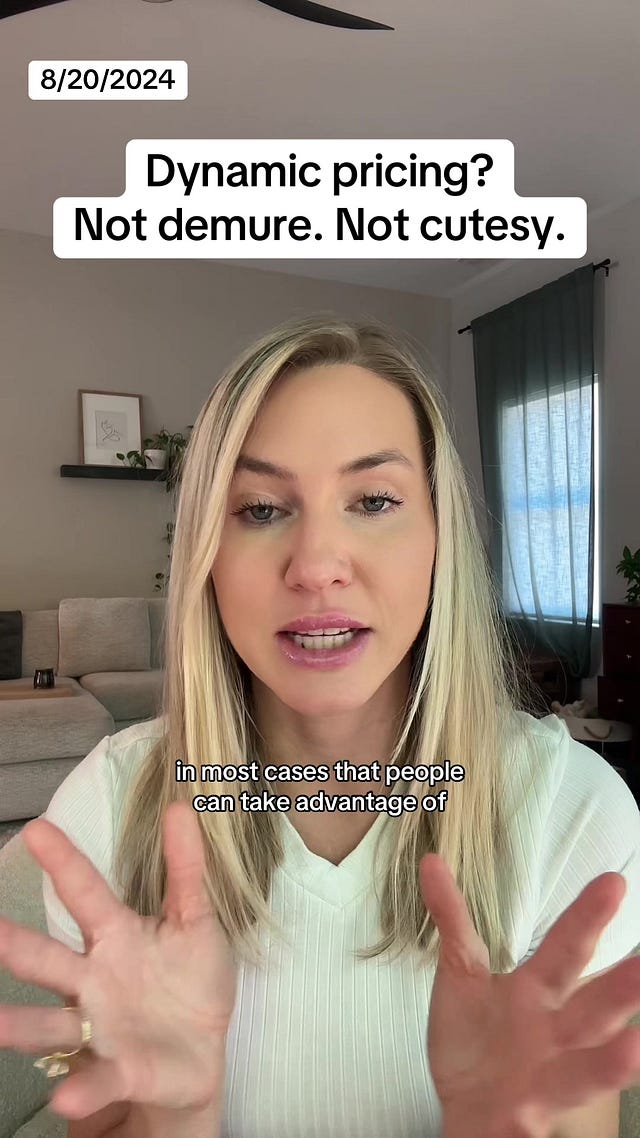
WATCH: Kroger’s Dynamic Pricing
Here’s some content from my other mediums. Feel free to follow me on Instagram, TikTok or YouTube.
 Tiktok failed to load.
Enable 3rd party cookies or use another browser
A note: Dynamic pricing does not present only opportunities for misuse. It presents opportunities for benefit as well. But the stakes are high and this potential use of AI should be monitored closely.
Let’s Connect:
Connect with me on LinkedIn.
Looking for a speaker at your next AI event? Email thepaigelord@gmail.com.
Email thepaigelord@gmail.com if you want to connect 1:1.