

Google appears to backpedal on Bard…but that might be good for responsible AI?
Also, ChatGPT as a therapist: yes or no? Take the poll or share your comments below!

Info:
After years on top of the search game, Google has had a rough few weeks. This shouldn’t be surprising, because every company has it’s time. In an all-hands meeting, an employee asked a question: “why should the first application [of Bard] be search?”
Jack Krawczyk replied,
“I just want to be very clear: Bard is not search...It’s an experiment that’s a collaborative AI service…The magic we’re finding in using the product is really around being this creative companion to helping you be the sparkplug for imagination, explore your curiosity, etc.”
One article I read indicated that Google has pivoted their messaging since the rollout of Bard, and hints that this change in direction could be an effort to distance itself from its rollout in Paris, which struggled in more than one way.
Employees are saying that messaging from top execs is confusing, and it’s unclear what the strategic direction is.
My opinion:
While it does appear that Google is consciously decoupling Bard from search for brand and Wall Street purposes, I actually think they’re making a fair point. The world jumped onto LLMs like ChatGPT very quickly, and, in my opinion, there wasn’t enough time to clearly and broadly spread the message that an LLM is not perfect, it’s not trustworthy and it’s not your friend. I think that this technology (LMMs in general) could have had a better rollout had the risks been shared upfront, and if companies had done what Google is doing now - clearly stating that these LLMs are creative sidekicks and productivity aides - not know-all technical entities.

Let me start by saying this very clearly: NO.
Recently, a mental health advocate and influencer on TikTok (who have have a tremendous amount of respect for) encouraged their followers to use ChatGPT as a therapist. To tell it their deepest, darkest secrets. To ask it for advice.
I reached out to them and respectfully shared the reasons why this is dangerous and they graciously put a disclaimer on their post, but thought it would be helpful to share my thoughts here.
As many of you know, ChatGPT et al., are large language models (LLMs). They are not alive. They are not sentient, contrary to what some are saying. LLMs take an input, run it through neural networks, which are a series of coded algorithms, and provide an output. LLMs like ChatGPT are super impressive, but they are not smart, per se. They’re limited by the data they have available to them and while they can “learn” good things and bad things, they cannot reason, which is an essential part of navigating mental health.
I know people will push back, so I asked ChatGPT “Should I use ChatGPT as my therapist?”
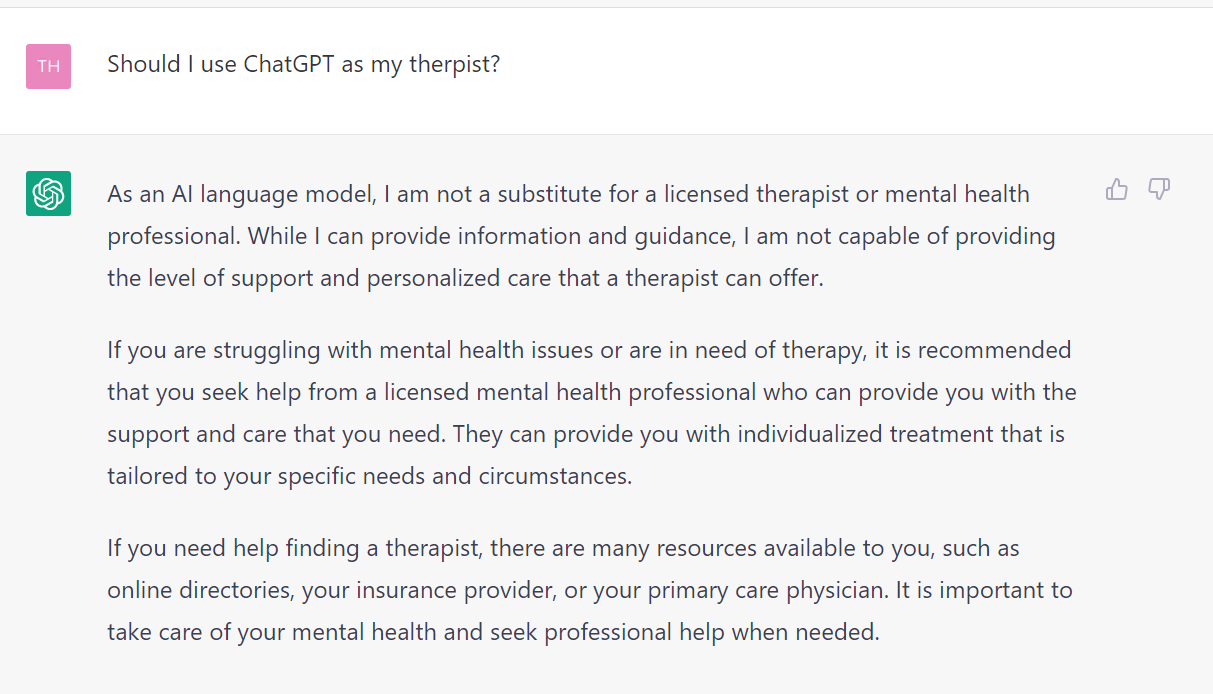
It’s a safe answer which will help keep OpenAI and Microsoft out of legal trouble in this case.
Here are some risks of using ChatGPT as a therapist:
People who don’t know how AI works might become emotionally overly dependent on the advice of the LLM, which can never set boundaries or be a true friend
People might get bad advice and follow it, and we don’t currently have legal guidance on who bears the responsibility when that happens
People might be fed mis or disinformation and believe it to be true
People might get great advice, and then never go to an actual therapist
These are just a few examples of the risks. The desire for people to point others toward ChatGPT as a therapist is no doubt rooted in a large social problem - access to mental healthcare limited and the healthcare itself is expensive. There is an entire portion of the United States that couldn’t pay $80 a week toward therapy even if they wanted to.
So, if you want to improve the lives of people on a mental health and wellness journey, please don’t point them to ChatGPT because it can’t really help for long term wellness. Make a donation to a nonprofit focused on mental health. Pay for someone’s therapy. Do something actionable to get people the help they need. ChatGPT is a great tool, but it’s not a mental health tool

Fiddler AI cares about the trustworthiness of your AI model. It’s a Model Performance Management platform that enables organizations monitor, explain, analyze and improve the trustworthiness of their AI models. It’s user friendly, offers complete model lifecycle capabilities, aligns your teams across data science, engineering and other business groups, offers high-end support, and they have a clear responsible AI mission.
Explainability is a massive conversation in the AI world right now. People are recognizing that it’s not reasonable to give AI an input and receive an output without understanding the logic that occurred in between. Fiddler AI is a leader in MPM and they’re leading the way in explainable AI. They’re definitely one to watch, and they’re hiring, too!

AI is being used to scam your loved ones
Is ChatGPT just another crypto craze? Vox doesn’t think so.

I regularly get asked how people can get into responsible AI, so here are some resources! I’ll keep adding to this list as I come across more information.
Responsible AI Institute is a nonprofit dedicated to helping organizations on their responsible AI journey. They provide awesome ways for their members to get connected through their Slack channel, get resources through their newsletter, and get invited to community events. Plus they’re a leader in responsible AI, so they’re a company to watch.
The Center for AI and Digital Policy offers policy clinics, and they look amazing. If you’re interested in AI policy, this might be for you! I’m hoping to apply for the Fall 2023 session.

Subscribe to my Substack if you want to receive this weekly update.
Connect with me on LinkedIn.
Email me if you want to talk about business: thepaigelord@gmail.com
Follow on TikTok, where I chat about responsible AI.